H I C O A g e n d a
— Upcoming events
***BOEKVOORSTELLING*** Bart Vandenabeele (UGent): Kunst op leven en dood
Donderdag 22 oktober, 19u30
Faculteitsbibliotheek, Atrium
***LECTURE*** by Marie McGinn (York University): Wittgenstein's Tractatus as a War Book
Tuesday 27 October, 4pm
Faculty Room, Blandijn
Abstract:
Although Wittgenstein formulated many of the problems that are the focus of his logical reflections in the Tractatus before the war, the Tractatus is drafted and then written in its final form entirely within the context of the First World War. Not only that, but the nature of the text was fundamentally changed by experiences and intellectual influences, particularly his reading of Tolstoy on the Gospels, that Wittgenstein underwent during the conflict. In the summer of 1916, immediately after Wittgenstein had been through some of the greatest challenges of the war, in three weeks of fierce fighting at the front during a major Russian offensive, the text shifted from the purely logical text of the earliest draft of the Prototractatus to a text which includes reflections on ethics. The change is so profound that Wittgenstein could write of the Tractatus, in a letter to von Ficker: “The book’s point is an ethical one.” The remarks on ethics that eventually found their way into the Tractatus, had their origin in remarks in the Notebooks that bear the clear mark both of Tolstoy’s influence and of the profound experiences that Wittgenstein had just been through at the Russian front. My aim in this talk is to see how looking at them in the light of the context in which they were written illuminates them and affects our interpretation of them.
Followed by a free reception, kindly offered by: HICO.
— Past events (Academic year 2025-2026)
***LECTURE*** by Till Hoeppner (University of Göttingen): Mental Acts and Representational Content in Descartes, Malebranche, Locke, and Kant: Completing Act-Based Propositions Through a Progression of Insights From Modern Philosophy.
With a response by Benjamin Hill (University of Western Ontario)
Tuesday 29 September, 4pm
[NEW LOCATION:] Room 2.25, Blandijn
This is a hybrid event. The link for the online session is: https://teams.microsoft.com/meet/34257648332965?p=MvvRDIre48pjqT17DF
Those who wish to attend, please send a confirmation e-mail to levi.haeck@ugent.be
Abstract:
The act-based approach to propositions, which identifies structured propositional contents with truth-apt act-types of predication, was recently introduced as a supposedly new alternative to the classical Russellian and Fregean views by Peter Hanks and Scott Soames. In this essay, I show that a view of this kind was in fact developed in a progression of insights from Modern Philosophy, starting from Descartes and Malebranche, gaining momentum in Locke and culminating in Kant, who fruitfully brings together the insights of his predecessors. This even allows to close some explanatory gaps left open by the recent adopters.
The first insight is Descartes’s and concerns the reality of representational content. As Descartes argues in the Third Meditation, for an idea to have what he calls objective reality, namely, for a representation to represent whatever it represents and thus relate to it, the representation needs to be grounded in some formal reality of the represented object and not only in a reality in the idea. The second insight is Malebranche’s and concerns the objectivity of representationalcontent. As Malebranche argues in Part 2 of Book 3 of his Search for Truth, for ideas to represent whatever they represent and be distinct entities with distinct features, ideas have to constitute a sui generis abstract and intersubjective logical space, which Malebranche identifies with God’s mind. The third insight is Locke’s and concerns the constitution of propositional representational content through acts of combination. As Locke argues towards the end of Book 2 and at the beginning of Book 4 of his Essay, for ideas to relate to objects in a way that is true or false, they must be combined through capacities of a mind, which ground four kinds of knowledge (see IV.1.3), and which mind Locke now identifies with our human understanding.
Finally, Kant’s Critique fruitfully brings together these insights of his predecessors by
- giving a systematic analysis of representational content in terms of fundamental acts of combination, in particular acts of judgment, which even correspond to Locke’s four kinds of knowledge, thereby taking up and transforming Locke’s insight;
- locating representational acts and contents in a sui generis abstract and intersubjective logical space, which he identifies with the discursive understanding (in contrast to God’s intuitive understanding), thereby taking up and transforming Malebranche’s insight; and
- linking the way concepts can relate to objects and their properties in judgment and be true or false of them to the possibility to have empirical intuitions (i.e., sense perceptions) of them, thereby taking up and transforming Descartes’s insight.
***STUDY DAY*** Idesça: Hurrah For the Small Difference?
Wednesday 13 May, 9am-5pm
Hartentroef, Heilig Hartplein 1, 9040 Gent
REGISTRATION REQUIRED: See poster for information, or visit the website: https://idesca-vzw.be/hurrah-for-the-small-difference/
******F L A G S H I P E V E N T******
Lecture by Katrien Schaubroeck (Universiteit Antwerpen): Imagining Death. Iris Murdoch and autobiographical despair.
Thursday 7 May, 4pm
Location: Faculteitszaal, Blandijn
Abstract:
Anthropologists since Ernest Becker have been criticising the tendency of death denial in the secular western society. Yet there is a real question what is meant by death denial, and what a valuable alternative would be. In this talk I will focus on Iris Murdoch’s moral philosophy that, basically, urges us to accept reality as it is. With regard to the reality of mortality she complains that “Christianity and romanticism tend to transform the idea of death into the idea of suffering.” (1970) Her cultural analysis differs from Becker’s. Not denial but distortion is the problem, she says. The acceptance of death, not as an affliction but as the absolute void, is a moral achievement for Murdoch. Murdoch has been criticized for encouraging self-annihilation and self-depreciation as if these are morally superior attitudes, embodying a figurative death in preparation of real death. I believe this criticism is unfair. In my reading of Murdoch’s philosophical writings on mortality and her novel Bruno’s Dream (1996) – which I argue could be read as a variation on The Death of Ivan Ilyich(1886) – she warns that mortality should not erode our sense of ourselves as important. Ivan Ilyich’s autobiographical despair is not the moral lesson Murdoch wants us to draw. In between autobiographical despair and death denial Murdoch inspires a different, lucid attitude towards death that I will explore in this talk.
Followed by a free reception, kindly offered by: HICO.
***LECTURE*** by Arantza Etxeberria (University of the Basque Country ): Reframing the signifiance of menstruation. Evolutionary insights from an organismal-relational perspective.
Thursday 23 April, 2pm
Location: 3.30 Camelot, Blandijn
Online attendance is possible: Please contact dries.josten@ugent.be for further information
Abstract:
Cultural stigma and medical pathologization have long shaped scientific and social perceptions of menstruation, limiting both research and clinical attention. This paper outlines three major sources of negative perceptions and examines their influence on scientific discourse and cultural attitudes. To counter these biases and misconceptions, evolutionary accounts of menstruation are explored, which emphasize its crucial role in human physiology and reproduction. Two evolutionary approaches to adaptation are compared: one adopts a functionalist stance that assigns specific functions to traits. While this perspective offers a naturalized and positive understanding of menstruation, it remains insufficient to capture the phenomenon’s full complexity. In response, the paper draws on a second approach, organismal and relational, which emphasizes whole-organism adaptation within developmental and ecological contexts. This contrast is also reflected in evolutionary medicine, where organismal approaches support integrative views of disease patterns. Revisiting late 20th-century debates on whether menstruation is adaptive or a byproduct, the paper presents key elements of the alternative organismal-relational perspective. This framework makes it possible to distinguish three broad categories of menstrual pathologies and supports the claim that organismal evolutionary perspectives offer a richer understanding of menstrual health.
***LECTURE*** by Laura Langone (University of Verona): Nietzsche on Food and Wellbeing
Tuesday 18 November, 4pm
Location: Faculteitszaal, Blandijn
Abstract:
If Nietzsche was one of the few Western philosophers to make our food habits a subject of philosophical inquiry, following in the footsteps of Feuerbach and few others, he was the first to advocate for a history of the philosophy of food, as well as for a study of the impact of food on our physiology and our morality. Also due to his own gastrointestinal issues, Nietzsche was particularly concerned with nutrition and read works on physiology and dietetics by some of the most renowned scholars of the 19th century. Building upon his knowledge of 19th-century science, Nietzsche devised a philosophical method to deal with the issue of nutrition so as to pursue the most one’s wellbeing as well as one’s goals.
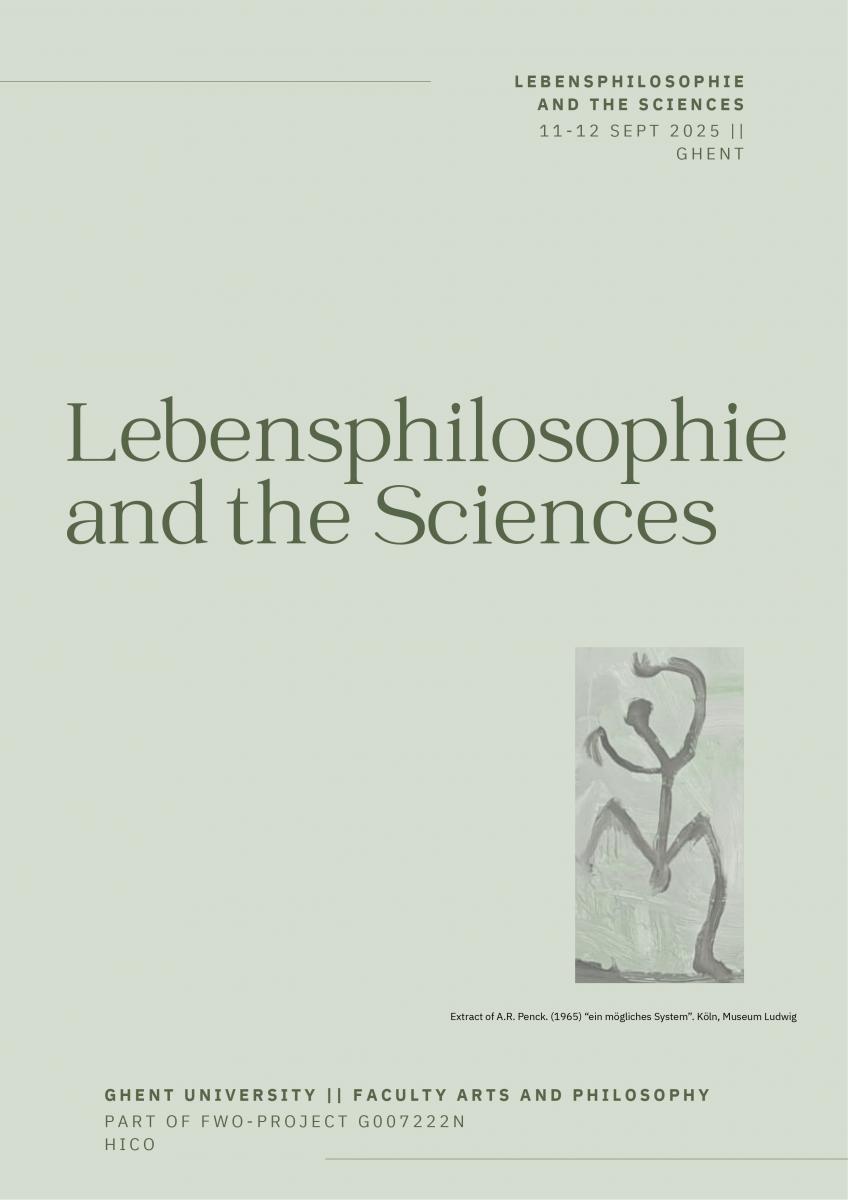
***WORKSHOP***: “Lebensphilosophie and the Sciences.”
Ghent University (Belgium), 11-12 September 2025
Poster and Program